Understanding of Employee Skills
Accurately see the skills and previous training employees and potential hires have.
For most of the construction industry's history, there hasn't been a consistent way to represent a craft professional's knowledge and abilities. Contractors couldn't truly verify someone's skills until they picked up their tools and went to work.
But today, standardized credentials give contractors and project owners more workforce insights than ever.
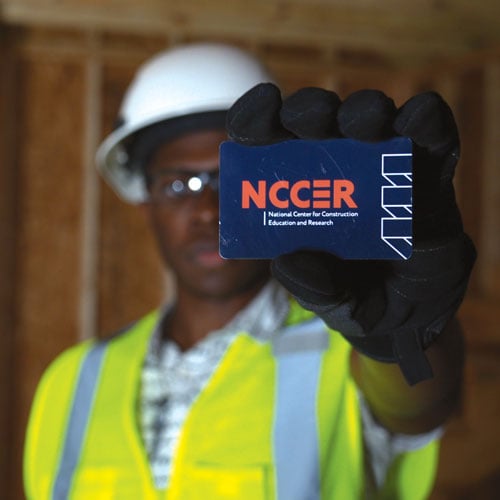

Credentials are the building blocks of any education program.
Just like degrees and transcripts track acheivements in academics, construction credentials highlight the significant training and career accomplishments of students, apprentices and craft professionals.
In short, Credentials = Qualifications.
Credentials issued by a national accrediting body are standarized and verifiable—meaning you can reliably know exactly what training someone has completed just by looking at their credentials.
Accurately see the skills and previous training employees and potential hires have.
Efficiently pick up training progress right where the learner is at in their career.
Support employee confidence and loyalty by investing in career development.
Boost project bids by using skilled, verifiably credentialed professionals.

Learners in NCCER training programs have the opportunity to earn official credentials as indicators of achievement and progress through various stages of their education. Some of the ways credentials can be earned include:
Successful completion of online module tests
Successful completion of hands-on performance profiles
Successful completion of all modules of a craft level (ex: Electrical Level 1)
Successful completion of all levels of a full craft curriculum (ex: Electrical Levels 1-4)
Credentials can only be earned through an approved NCCER-accredited Training Program.
Whereas training credentials are earned by students and entry-level trainees going through an NCCER training program, journey-level certifications are built for craft professionals that already have several years of experience.
At NCCER, a craft certification is considered a specific type of credential that is earned through completion of a Journey-Level Assessment (written knowledge test) and a Performance Verification (hands-on tasks) that evaluate proficiency across key job functions.
Candidates who earn both a Knowledge Verified credential and Performance Verified credential also earn an official NCCER Journey-Level Certification for their craft.
Certifications can only be earned through an approved NCCER-accredited Assessment Program.
Similar to standard journey-level certifications, Crane, Rigger and Signal Person Certifications include both a knowledge-focused Assessment and a performance-focused Practical Examination. Professionals who successfully complete both the assessment and practical examination of a specific certification pathway are considered NCCER Certified.
These certifications can only be earned through an approved NCCER-accredited Assessment Program that has been endorsed to specifically deliver the Crane, Rigger and Signal Person programs.
NCCER's Construction Leadership Series allows current or prospective foremen and superintendents to develop key leadership skills and earn formal certification.
Passing the Superintendent or Foreman assessment, in addition to meeting minimum experience requirements, confers the respective certification.
The Construction Leadership Series is a standalone product; Superintendent and Foreman Certifications do not need to be conducted through an NCCER-accredited program.
Specific personnel roles within NCCER-accredited programs, including craft instructors, proctors and performance evaluators, earn personnel certifications upon successful completetion of role-based training programs.
NCCER credential holders can access and share their credentials and certifications within their NCCER Account Dashboard and through the NCCER Digital Wallet.
Any employer can verify the NCCER credentials of someone by inputting the individual's NCCER Number into the NCCER Credential Search tool.


NCCER's standardized training and credentialing model serves secondary, postsecondary and professional organizations nationwide.
That means that the credentials a student earns at an NCCER-accredited high school or college are the same ones recognized and used by NCCER-accredited contractors. This vertical articulation makes it easy for construction employers to build talent pipelines from local educational institutions and seamlessly continue a learner's training.
Ready to start training, credentialing and certifying your workforce, or simply want to learn more about how NCCER's credentialing system works? Fill out the form below to connect with one of our Workforce Development representatives.